Major Arcana · XIII
Death tarot card meaning: upright and reversed
Death is the card of endings that make room. It is never about physical death. It marks the close of a chapter, a role, a habit or a phase, and the change that follows when you let it go.
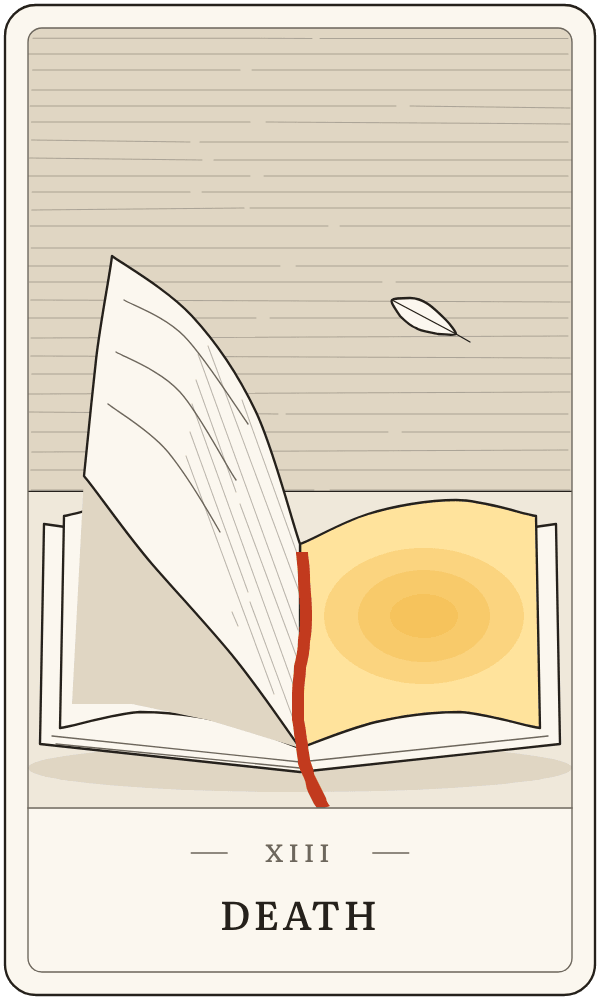
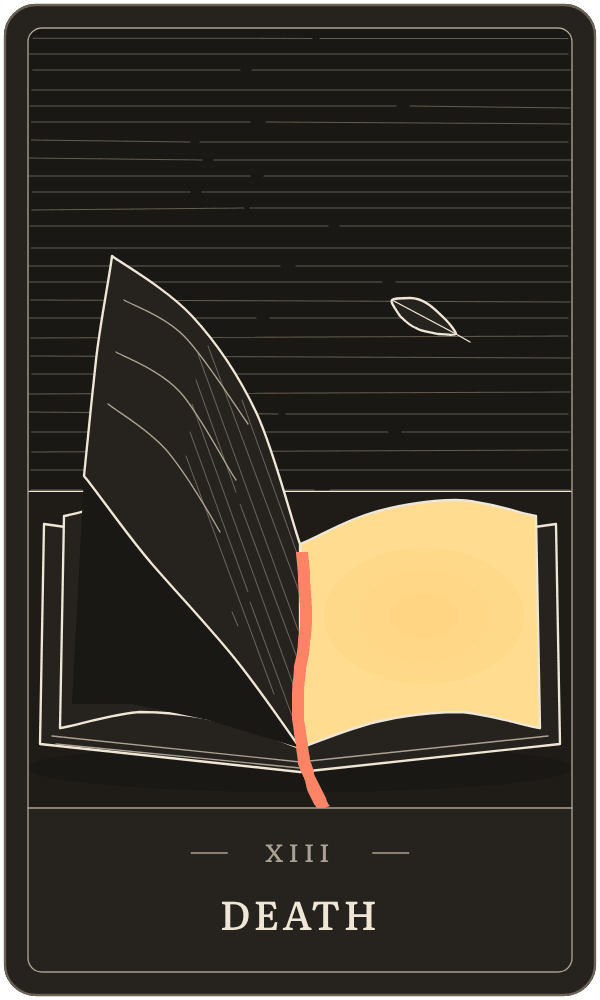
- Upright
- transformation, endings, transition, release, renewal
- Reversed
- resisting change, holding on, stagnation, slow transition
- Yes or no
- Leans no upright; leans no reversed
Death upright
transformation · endings · transition · release · renewal
Death is a card of transformation and endings, never a sign of physical death. It marks the close of one chapter so that something new can begin, inviting you to release what has run its course. Change of this kind can feel hard, but it clears space for renewal.
Upright, Death often shows up when something has run its course: a job you’ve outgrown, a story you tell about yourself, a pattern in how you love, a season of life. It asks you to stop holding the old page flat. Endings can be sad and freeing at once, and the card leaves room for both.
What are you ready to let go of so something new can grow?
Death reversed
resisting change · holding on · stagnation · slow transition
Reversed, Death suggests you may be resisting a change that’s ready to happen, holding on to something that has already ended. The card is still about transformation, not physical death; reversed, it points to a fear of letting go and the stagnation that can follow. Gently loosening your grip may help the next chapter begin.
Reversed, the page is held mid-turn. You may be clinging to something that has already ended, or dreading a change you know is coming. The card is still about transformation, never about dying. It points to the stuck, airless feeling of refusing to turn the page, and suggests loosening your grip a little.
What would it feel like to let this chapter close?
Death in love
Upright
In love, Death can point to the end of an old pattern, phase or way of relating, making room for something more honest. It may mark a deep shift in how you approach love.
Reversed
In love, this can reflect clinging to a relationship, a past partner or a pattern that no longer serves you. It invites you to honor what was and allow room for what could be.
Death at work
Upright
At work, it highlights transition: one direction closing so another can open. It invites you to let go of what no longer fits and consider what you want next.
Reversed
At work, it may point to staying in a role or routine out of fear of change. Notice what you’re holding on to, and why.
Death as feelings
For questions like “How do they feel about me?” The card describes a possible mood, never what someone really thinks.
Upright
A mood this card can describe: something between you changing deeply, an old pattern ending. What do you sense is closing, and what might begin?
Reversed
A mood this card can describe: fear of change and holding on to how things were. What are you each holding on to?
Is Death a yes or no card?
Upright
Leans no. Death: a chapter closing, so the old answer may not apply.
Reversed
Leans no. Death reversed: holding on to a page that has already turned.
A lean is the card’s mood, not a verdict. Yes or no tarot can’t answer questions about health, pregnancy, money, the law or what someone else will do. Draw one card for a yes or no question, or see every card’s lean.
Death in Lanterndeck’s deck
Traditional decks show a skeleton in armor on a white horse, carrying a black banner, with figures fallen or kneeling before it. Lanterndeck draws none of that. Our Death card is a notebook page mid-turn: the lamp falls on the blank page beneath, a pressed leaf drifts out, and the vermilion bookmark ribbon keeps your place. One page ends so the next can be written.
Death in a spread
In a three-card reading
- In the past position, Death points to an ending that cleared the way for where you are now.
- In the present, it suggests something is finishing, and that resisting it may be harder than letting it go.
- As what’s coming into view, it shows a transition: one chapter closing and the next beginning.
In a Celtic Cross
- Crossing you, it can show reluctance to let go of something that has already changed.
- As where things are heading, it leans toward renewal after an ending.
How the positions work: the three-card spread and the Celtic Cross, position by position.
Death with other cards
Death and The Tower
Change that’s fast and change that’s final. What is ready to go, and what’s being cleared?Death and The Star
An ending followed by hope, one of the gentlest pairs in the deck after a hard time.Death and Wheel of Fortune
A turn of the cycle: endings as part of a larger pattern.Death and Six of Swords
Moving on from something, slowly and steadily, toward calmer water.
What Death doesn’t mean
Death in tarot is not a prediction that anyone will die, and it isn’t a warning about health. That reading belongs to films, not to the deck’s tradition. On Lanterndeck it always means change, endings and transition.
Death by the numbers
| In a one-card draw | 1 in 78 (1.3%) |
|---|---|
| In a three-card spread | 1 in 26 (3.8%) |
| In a ten-card Celtic Cross | about 1 in 8 (12.8%) |
| Reversed, when it turns up | about 1 in 3 in Lanterndeck’s draw |
Death is card XIII of the Major Arcana, the fourteenth of its 22 steps, between The Hanged Man and Temperance. With 22 Majors in a deck of 78, a three-card spread holds at least one of them about 64 times in 100.
Draw with Death in mind
Ask your own question and draw three cards from the full deck. Death may turn up or it may not: the draw is random, and the reading works with whatever comes.