Major Arcana · XVI
The Tower tarot card meaning: upright and reversed
The Tower is the card of sudden change: the moment something built on a shaky foundation gives way. It can be unsettling, but it often clears away a pretense and leaves something more honest.
- Upright
- upheaval, sudden change, revelation, awakening, broken illusions
- Reversed
- resisting change, inner upheaval, fear of disruption, personal transformation
- Yes or no
- Leans no upright; leans no reversed
The Tower upright
upheaval · sudden change · revelation · awakening · broken illusions
The Tower represents sudden change, when something built on shaky foundations gives way. It can feel unsettling, yet it often brings a revelation or a clearing that makes room for something more honest and stable. This card reminds you that what falls away may have needed to fall.
Upright, the Tower tends to show up around revelations: a truth that changes how you see something, a plan that collapses, an illusion that stops working. It asks you to let what was false fall, and to notice what’s still standing. Sudden change is hard, and the card doesn’t pretend otherwise. It also points to what becomes possible once the dust settles.
What would you build if you could start again on firmer ground?
The Tower reversed
resisting change · inner upheaval · fear of disruption · personal transformation
Reversed, the Tower can mean you’re resisting or putting off a change that feels inevitable, or that the upheaval is happening inside you rather than around you. You may be propping up walls that need to come down. The card invites you to face the shift gently and on your own terms.
Reversed, the house of cards is wobbling but still up. You may be propping up something you know is unstable, or the upheaval may be inside you, a belief or a self-image quietly coming apart. The card suggests facing the shift gently and on your own terms, rather than waiting for it to fall.
What change are you bracing against, and what might it free you from?
The Tower in love
Upright
In love, the Tower can reflect a shake-up, a surprising truth or a moment that changes how you see a relationship. Clarity, even when uncomfortable, can lead to something more real.
Reversed
In love, this can reflect avoiding a necessary conversation or holding things together just to keep the peace. It invites you to consider what honesty might open up.
The Tower at work
Upright
At work, it may point to an unexpected shift or a plan that wasn’t working falling apart. It invites you to rebuild on stronger foundations and clearer priorities.
Reversed
At work, it may point to sensing that change is needed but avoiding it, or a personal shift in what you want from your work. Small, deliberate changes may feel easier than waiting for a big one.
The Tower as feelings
For questions like “How do they feel about me?” The card describes a possible mood, never what someone really thinks.
Upright
A mood this card can describe: being shaken up or stirred, intense and unsettled. What changed recently, and how did you each react?
Reversed
A mood this card can describe: unease about change, or something private being worked through. What do you know for sure, and what are you guessing?
Is The Tower a yes or no card?
Upright
Leans no. The Tower: the ground shifting under the question itself.
Reversed
Leans no. The Tower reversed: a shake-up held off, not settled.
A lean is the card’s mood, not a verdict. Yes or no tarot can’t answer questions about health, pregnancy, money, the law or what someone else will do. Draw one card for a yes or no question, or see every card’s lean.
The Tower in Lanterndeck’s deck
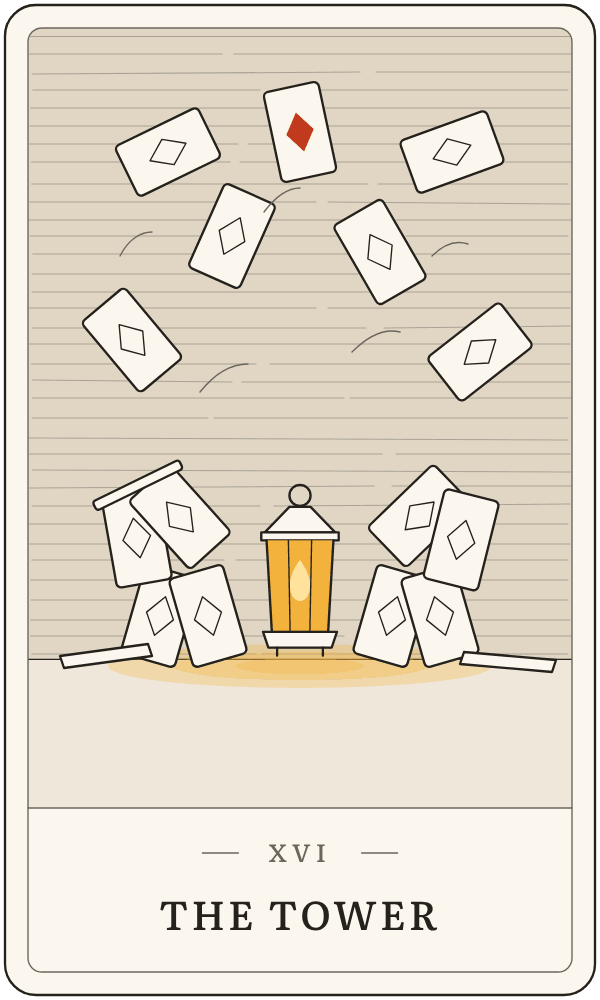
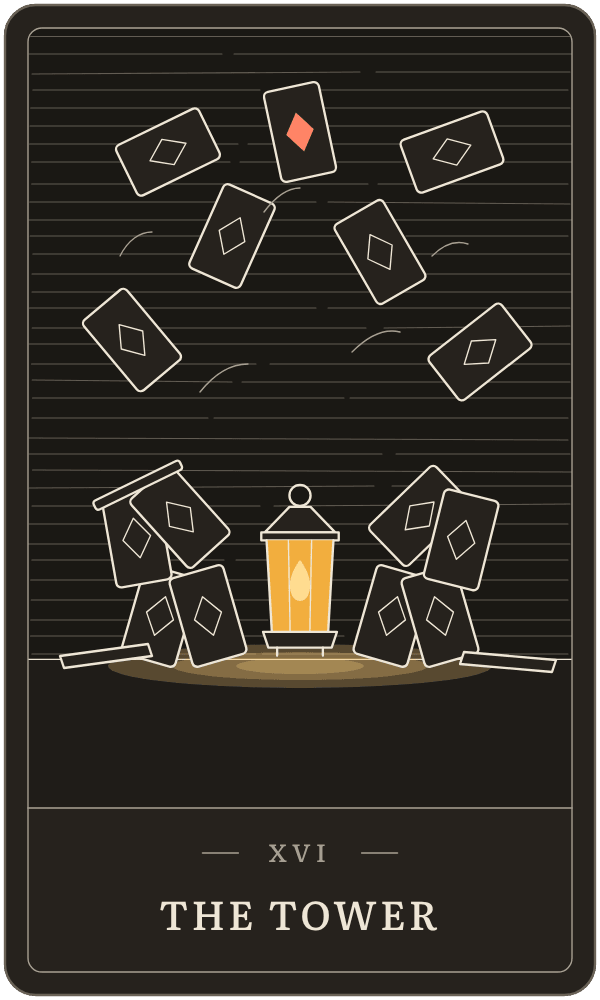
Traditional Towers are struck by lightning, flames pouring from the windows and two figures falling. Lanterndeck draws a house of cards coming down, and the lamp it had been hiding now standing in plain view, with a vermilion thread on one of the falling cards. Nothing here is a disaster: a structure that was never solid falls, and the light was there all along.
The Tower in a spread
In a three-card reading
- In the past position, the Tower points to a disruption that reshaped this situation and perhaps cleared the ground.
- In the present, it suggests something unstable is being exposed, and resisting may be harder than letting it fall.
- As what’s coming into view, it shows a change of perspective, sometimes abrupt, that clears the air.
In a Celtic Cross
- Crossing you, it can show fear of disruption, or a foundation that won’t hold much longer.
- As where things are heading, it leans toward a more honest footing after a shake-up.
How the positions work: the three-card spread and the Celtic Cross, position by position.
The Tower with other cards
The Tower and Death
Sudden change and deep change together. What is ending, and what is being cleared to make room?The Tower and The Star
Hope after upheaval. The Star follows the Tower in the deck’s order, and the pair carries that story.The Tower and Five of Pentacles
A hard stretch after a shake-up, and a reminder to look for the help that’s nearby.The Tower and The Devil
A pattern that breaks once it’s seen.
What The Tower doesn’t mean
The Tower doesn’t predict an accident, a disaster or bad news, and Lanterndeck never reads it as a forecast. It describes how change can feel when it arrives all at once, and what it can reveal.
The Tower by the numbers
| In a one-card draw | 1 in 78 (1.3%) |
|---|---|
| In a three-card spread | 1 in 26 (3.8%) |
| In a ten-card Celtic Cross | about 1 in 8 (12.8%) |
| Reversed, when it turns up | about 1 in 3 in Lanterndeck’s draw |
The Tower is card XVI of the Major Arcana, the seventeenth of its 22 steps, between The Devil and The Star. With 22 Majors in a deck of 78, a three-card spread holds at least one of them about 64 times in 100.
Draw with The Tower in mind
Ask your own question and draw three cards from the full deck. The Tower may turn up or it may not: the draw is random, and the reading works with whatever comes.