Major Arcana · V
The Hierophant tarot card meaning: upright and reversed
The Hierophant is the card of the shared path: teachers, traditions, communities and the wisdom that gets handed down. It asks what you’ve learned from others, and which of those lessons you still choose to keep.
- Upright
- tradition, guidance, shared values, learning, belonging
- Reversed
- rebellion, nonconformity, questioning, personal beliefs
- Yes or no
- Leans yes upright; leans no reversed
The Hierophant upright
tradition · guidance · shared values · learning · belonging
The Hierophant represents tradition, shared beliefs and the wisdom passed down through teachers, communities and institutions. It may point to learning from a mentor, following an established path or finding comfort in ritual and belonging. This card asks how your values connect you to something larger than yourself.
Upright, the Hierophant often shows up when you’re learning something properly: a course, an apprenticeship, a mentor’s advice, a practice with deep roots. It can also point to the comfort of belonging, to rituals and shared values that steady you. It asks which guidance has earned your trust, and whether you’re open to it.
Which traditions or beliefs truly feel like yours, and which did you simply inherit?
The Hierophant reversed
rebellion · nonconformity · questioning · personal beliefs
Reversed, the Hierophant invites you to question rules, conventions or beliefs that no longer fit. You may feel restricted by tradition or by other people’s expectations, and ready to find your own way. This can be a healthy break from the norm, as long as you’re moving toward something and not only away.
Reversed, the waymark starts to feel like a fence. You may be outgrowing a rule, a role or a belief that once fit, or chafing at someone else’s idea of how things are done. Questioning is healthy here. The card’s only caution is to move toward something of your own, not just away from what you were given.
What rule are you ready to rewrite for yourself?
The Hierophant in love
Upright
In love, the Hierophant favors commitment, shared values and traditional milestones. It points to relationships built on mutual respect and common ground.
Reversed
In love, this can point to an unconventional relationship, differing values or pressure to follow a script that doesn’t suit you. It invites you to define what commitment means to you.
The Hierophant at work
Upright
At work, it highlights learning, training, mentorship and working within established systems. Following proven methods may serve you well right now.
Reversed
At work, it may reflect frustration with rigid structures or a pull toward a less traditional path. Notice which rules help you and which only hold you back.
The Hierophant as feelings
For questions like “How do they feel about me?” The card describes a possible mood, never what someone really thinks.
Upright
A mood this card can describe: serious, respectful interest that values loyalty and doing things properly. What do you know about what they want, from what they’ve said?
Reversed
A mood this card can describe: restlessness with expectations, and a wish for something that doesn’t follow the usual rules. Have the two of you talked about what each of you wants?
Is The Hierophant a yes or no card?
Upright
Leans yes. The Hierophant: the well-trodden path, with good guidance along it.
Reversed
Leans no. The Hierophant reversed: the usual rules no longer fit.
A lean is the card’s mood, not a verdict. Yes or no tarot can’t answer questions about health, pregnancy, money, the law or what someone else will do. Draw one card for a yes or no question, or see every card’s lean.
The Hierophant in Lanterndeck’s deck
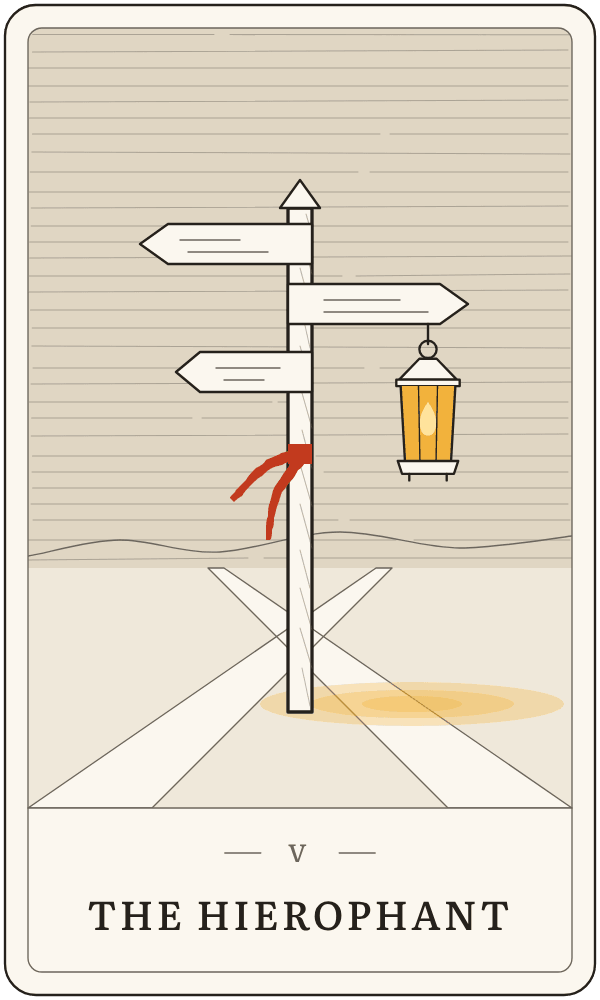
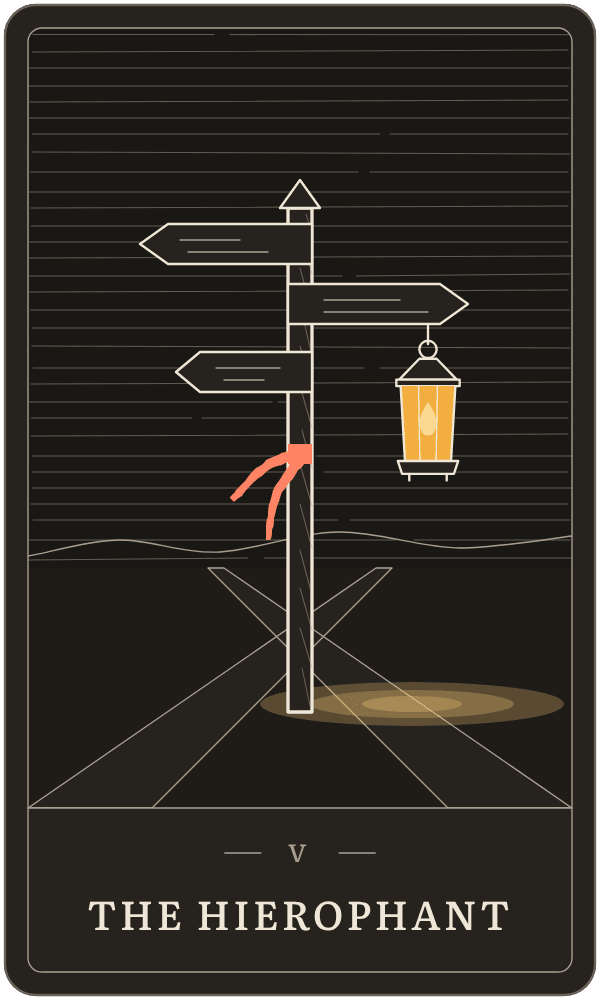
Traditional decks show a robed religious figure raising a hand in blessing over two kneeling followers, crossed keys at his feet. Lanterndeck leaves the figure and the ceremony out. We draw a waymark post at an old crossing with a lantern hung on it, and a vermilion ribbon tied there by an earlier traveler. Guidance, in this deck, is a light left by someone who walked this way before you.
The Hierophant in a spread
In a three-card reading
- In the past position, it points to a teacher, a tradition or a set of expectations that shaped how you approach this.
- In the present, it suggests looking for good guidance, or noticing whose rules you’re following.
- As what’s coming into view, it shows learning, mentoring or a community that could support you.
In a Celtic Cross
- Crossing you, it can show pressure to do things the expected way, or a rule that no longer fits.
- As where things are heading, it leans toward a choice about which traditions to keep and which to rewrite.
How the positions work: the three-card spread and the Celtic Cross, position by position.
The Hierophant with other cards
The Hierophant and The High Priestess
Outer teaching and inner knowing. Does the advice you’ve been given match what you sense?The Hierophant and The Fool
The established path and the untried one, often a question of whether to follow the map or leave it.The Hierophant and Three of Pentacles
Learning a craft from people who know it, a strong pair for study and apprenticeship.The Hierophant and The Lovers
Values and commitment. The pair often comes up around choosing what, and whom, to commit to.
What The Hierophant doesn’t mean
The Hierophant isn’t a religious ruling, and it doesn’t tell you what your faith says. Lanterndeck reads it symbolically, as guidance and tradition in general. If your question is about your faith, a knowledgeable person in your own tradition is the one to ask.
The Hierophant by the numbers
| In a one-card draw | 1 in 78 (1.3%) |
|---|---|
| In a three-card spread | 1 in 26 (3.8%) |
| In a ten-card Celtic Cross | about 1 in 8 (12.8%) |
| Reversed, when it turns up | about 1 in 3 in Lanterndeck’s draw |
The Hierophant is card V of the Major Arcana, the sixth of its 22 steps, between The Emperor and The Lovers. With 22 Majors in a deck of 78, a three-card spread holds at least one of them about 64 times in 100.
Draw with The Hierophant in mind
Ask your own question and draw three cards from the full deck. The Hierophant may turn up or it may not: the draw is random, and the reading works with whatever comes.