Major Arcana · IV
The Emperor tarot card meaning: upright and reversed
The Emperor is the card of structure: the walls, plans and agreements that make it safe to build something. His authority comes from being steady and fair, not from being loud.
- Upright
- structure, authority, stability, leadership, protection
- Reversed
- rigidity, control, domination, lack of discipline
- Yes or no
- Leans yes upright; leans no reversed
The Emperor upright
structure · authority · stability · leadership · protection
The Emperor stands for order, structure and steady leadership. He asks you to set clear boundaries, make a plan and take responsibility for building something that lasts. His strength comes from discipline and reliability rather than force.
Upright, he tends to come up when something needs a frame: a plan, a schedule, a boundary, a promise kept. He asks you to take responsibility for the shape of things and to be the reliable one, including with yourself. Order here isn’t rigidity. It’s what lets the rest of life feel less chaotic.
Where would a clearer boundary or structure make your life feel steadier?
The Emperor reversed
rigidity · control · domination · lack of discipline
Reversed, the Emperor’s structure can harden into rigidity or slip into chaos. You may be dealing with someone who is overly controlling, or struggling to bring order and discipline into your own life. The card invites you to find a kind of authority that feels fair, flexible and your own.
Reversed, the hearth either turns into a fortress or loses its walls. You may be dealing with someone controlling, or with your own urge to manage every detail. Or the structure is missing entirely and everything feels loose. The card asks what kind of authority would feel fair: firm where it needs to be, and flexible everywhere else.
Where are you holding on too tightly, or not tightly enough?
The Emperor in love
Upright
In love, the Emperor points to commitment, stability and a protective, dependable approach. It favors clear expectations and showing up consistently.
Reversed
In love, this can reflect power struggles, possessiveness or a partner who wants things only their way. It invites you to look at where control is replacing trust.
The Emperor at work
Upright
At work, this card highlights leadership, organization and taking charge of your direction. It’s a good moment to set goals, create systems and own your decisions.
Reversed
At work, it may point to a difficult boss, rigid rules or a lack of direction that leaves things scattered. Consider where you can lead yourself more clearly.
The Emperor as feelings
For questions like “How do they feel about me?” The card describes a possible mood, never what someone really thinks.
Upright
A mood this card can describe: protective, steady care shown through actions more than words. What have they done that felt reliable?
Reversed
A mood this card can describe: a pull toward control, or strong feeling that comes out as stubbornness. How do you feel when you’re around that?
Is The Emperor a yes or no card?
Upright
Leans yes. The Emperor: a steady plan and solid ground to build on.
Reversed
Leans no. The Emperor reversed: control gripped too tightly to move.
A lean is the card’s mood, not a verdict. Yes or no tarot can’t answer questions about health, pregnancy, money, the law or what someone else will do. Draw one card for a yes or no question, or see every card’s lean.
The Emperor in Lanterndeck’s deck
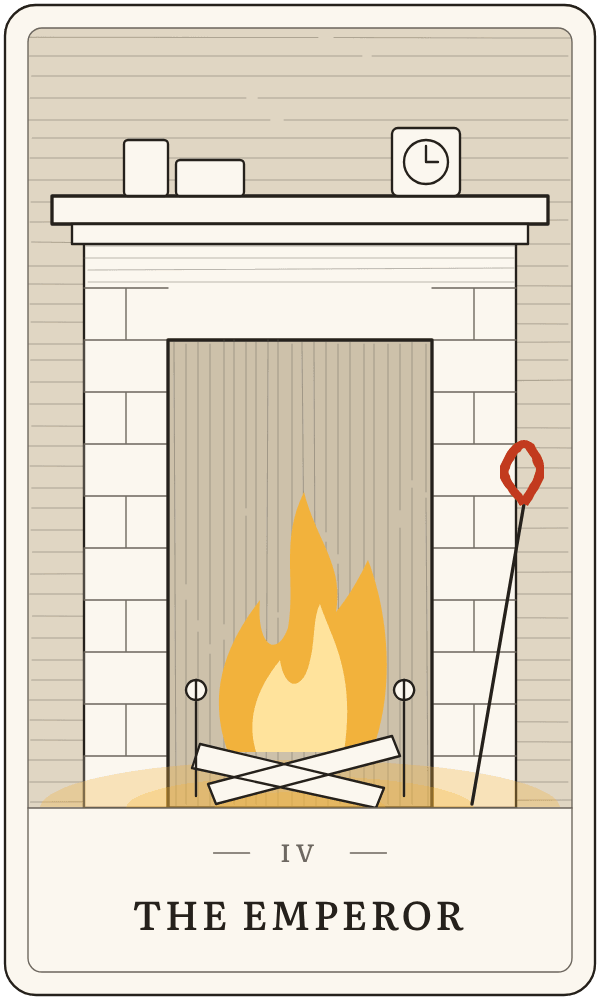
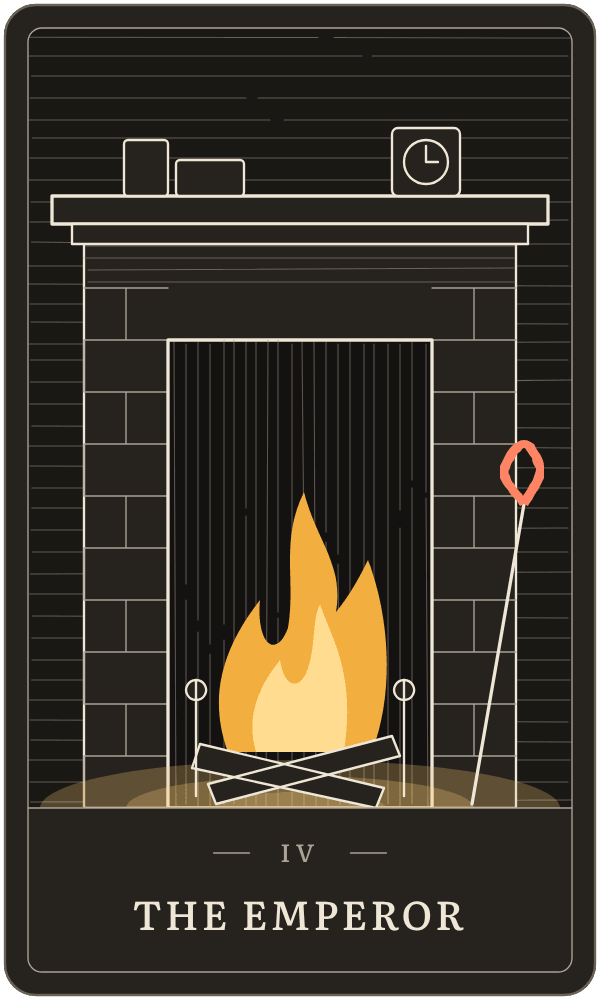
Traditional Emperors sit on a stone throne carved with rams’ heads, armored under a red robe, with bare mountains behind. Our Emperor is a squared stone hearth holding a fire, a vermilion loop on the fire iron beside it. A hearth is structure that exists for warmth: the walls are there so the fire can burn safely and be shared.
The Emperor in a spread
In a three-card reading
- In the past position, he points to a structure, a rule, a role or a person, that gave you stability or that you pushed against.
- In the present, he suggests the situation needs a plan, a boundary or a decision that someone owns.
- As what’s coming into view, he shows things becoming more settled as a framework takes shape.
In a Celtic Cross
- Crossing you, he can show rigidity, yours or someone else’s, or the strain of holding everything together alone.
- As where things are heading, he leans toward stability built through steady, deliberate choices.
How the positions work: the three-card spread and the Celtic Cross, position by position.
The Emperor with other cards
The Emperor and The Empress
Structure and nurture: a classic pair about how a home, a team or a project is held together.The Emperor and Four of Pentacles
Stability that may be tipping into holding on too tightly.The Emperor and Justice
Fairness built into the rules. The pair asks whether the structure you’re in is a fair one.The Emperor and The Chariot
A plan with drive behind it: discipline and momentum together.
What The Emperor doesn’t mean
The Emperor doesn’t mean someone powerful is about to step in, and he isn’t a ruling on any official, legal or workplace dispute. He describes a need for structure and steadiness, and asks where you could supply some.
The Emperor by the numbers
| In a one-card draw | 1 in 78 (1.3%) |
|---|---|
| In a three-card spread | 1 in 26 (3.8%) |
| In a ten-card Celtic Cross | about 1 in 8 (12.8%) |
| Reversed, when it turns up | about 1 in 3 in Lanterndeck’s draw |
The Emperor is card IV of the Major Arcana, the fifth of its 22 steps, between The Empress and The Hierophant. With 22 Majors in a deck of 78, a three-card spread holds at least one of them about 64 times in 100.
Draw with The Emperor in mind
Ask your own question and draw three cards from the full deck. The Emperor may turn up or it may not: the draw is random, and the reading works with whatever comes.