Major Arcana · XI
Justice tarot card meaning: upright and reversed
Justice is the card of looking honestly and weighing fairly. It’s about truth, accountability and the plain idea that choices have consequences, your own included.
- Upright
- fairness, truth, cause and effect, accountability, balance
- Reversed
- unfairness, dishonesty, imbalance, avoiding accountability
- Yes or no
- Maybe upright; leans no reversed
Justice upright
fairness · truth · cause and effect · accountability · balance
Justice asks you to look at a situation honestly and weigh it with fairness. It speaks of truth, integrity and the idea that choices have consequences, so owning your part matters. This card reflects fairness in your own decisions and relationships, not a forecast of any legal or official outcome.
Upright, Justice often appears when you need to be fair, to someone else or to yourself. It asks you to look at what actually happened, own your part and let others own theirs. It reflects fairness in your decisions and relationships; it doesn’t forecast how any official process will turn out.
If you looked at this situation with complete honesty, what would you see?
Justice reversed
unfairness · dishonesty · imbalance · avoiding accountability
Reversed, Justice can point to imbalance, unfairness or a reluctance to face the truth. You may feel something isn’t fair, or you may be avoiding responsibility for your own part. The card invites honesty with yourself, which is often the first step toward restoring balance.
Reversed, the scales tilt. Something may feel unfair, or you may be avoiding a truth that would cost you something to admit. The card is often less about other people’s wrongs than about your own clear sight. Honesty with yourself is usually the first step back toward balance.
Where are you avoiding a truth, or carrying more than your fair share?
Justice in love
Upright
In love, Justice points to honesty, balance and a relationship where both people are treated fairly. It invites clear, truthful communication.
Reversed
In love, this can reflect an uneven relationship, blame or a lack of honesty. It invites you to look at what each person is bringing.
Justice at work
Upright
At work, it highlights fairness, integrity and decisions made with clear reasoning. It invites you to weigh your options carefully and choose what you can stand behind.
Reversed
At work, it may point to feeling treated unfairly or to decisions made without the full picture. It invites you to act with integrity whatever others do.
Justice as feelings
For questions like “How do they feel about me?” The card describes a possible mood, never what someone really thinks.
Upright
A mood this card can describe: respect and a wish to be fair and honest. What has felt even, and what hasn’t?
Reversed
A mood this card can describe: defensiveness, guilt or a sense that things are out of balance. What would a fair conversation sound like to you?
Is Justice a yes or no card?
Upright
Maybe. Justice: the scales still weighing what’s fair.
Reversed
Leans no. Justice reversed: something out of balance that hasn’t been faced.
A lean is the card’s mood, not a verdict. Yes or no tarot can’t answer questions about health, pregnancy, money, the law or what someone else will do. Draw one card for a yes or no question, or see every card’s lean.
Justice in Lanterndeck’s deck
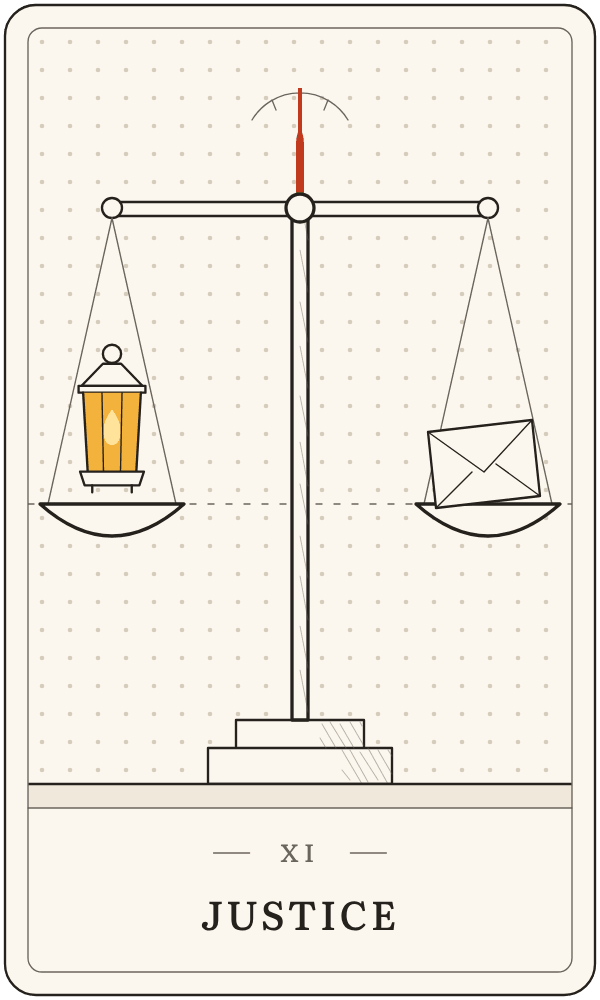
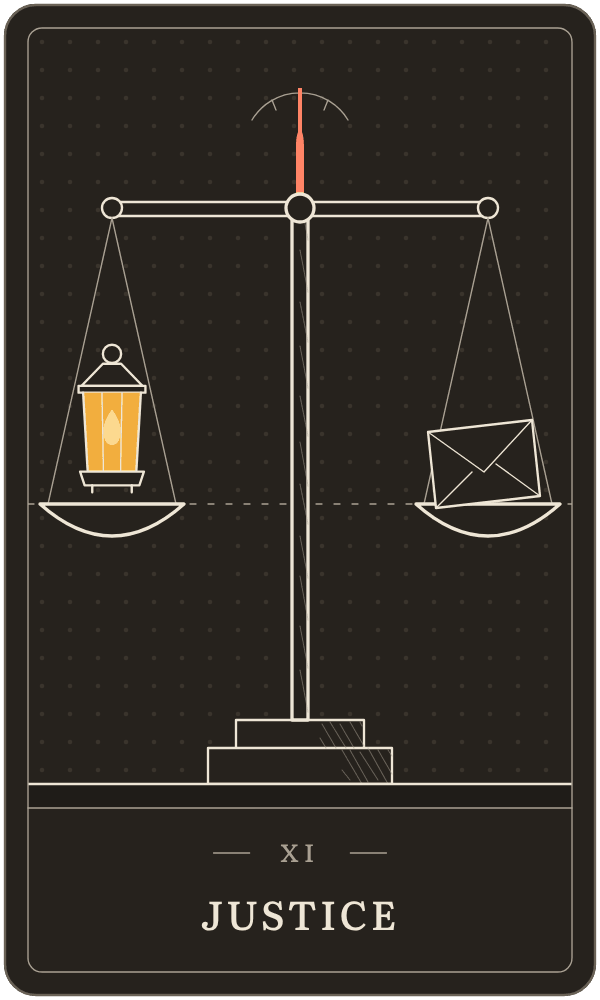
Traditional decks show a crowned figure between two pillars, a raised sword in one hand and scales in the other. Lanterndeck draws a balance with a lit lantern in one pan, level with a folded letter in the other, and a vermilion thread for its pointer. Light on one side, words on the other: truth weighed against what was said or promised.
Justice in a spread
In a three-card reading
- In the past position, Justice points to a decision or a consequence that still weighs on this question.
- In the present, it asks for an honest, even-handed look at the situation.
- As what’s coming into view, it shows clarity about cause and effect, and about what’s yours to own.
In a Celtic Cross
- Crossing you, it can show a sense of unfairness, or a truth you’d rather not face.
- As where things are heading, it leans toward balance restored through honesty.
How the positions work: the three-card spread and the Celtic Cross, position by position.
Justice with other cards
Justice and The Emperor
Fair rules and firm structure, a pair about responsibility.Justice and Two of Swords
A decision you’ve been avoiding. Justice asks you to weigh it honestly, then choose.Justice and The Lovers
A choice made with integrity: fair to someone else and to yourself.Justice and Judgement
Accountability and renewal together. Own what happened, then begin again.
What Justice doesn’t mean
Justice doesn’t predict the outcome of a court case, a dispute or any official decision, and Lanterndeck won’t read it that way. If you’re facing a legal question, a qualified professional is the person to ask. In a reading, the card is about your own fairness and honesty.
Justice by the numbers
| In a one-card draw | 1 in 78 (1.3%) |
|---|---|
| In a three-card spread | 1 in 26 (3.8%) |
| In a ten-card Celtic Cross | about 1 in 8 (12.8%) |
| Reversed, when it turns up | about 1 in 3 in Lanterndeck’s draw |
Justice is card XI of the Major Arcana, the twelfth of its 22 steps, between Wheel of Fortune and The Hanged Man. With 22 Majors in a deck of 78, a three-card spread holds at least one of them about 64 times in 100.
Draw with Justice in mind
Ask your own question and draw three cards from the full deck. Justice may turn up or it may not: the draw is random, and the reading works with whatever comes.