Major Arcana · XX
Judgement tarot card meaning: upright and reversed
Judgement is the card of the wake-up call: an inner sense that it’s time to rise into a truer version of yourself. It’s about honest reflection, forgiveness, and a fresh start built on what you’ve learned.
- Upright
- awakening, reflection, renewal, inner calling, self-evaluation
- Reversed
- self-doubt, harsh self-judgment, ignoring the call, regret
- Yes or no
- Leans yes upright; leans no reversed
Judgement upright
awakening · reflection · renewal · inner calling · self-evaluation
Judgement is a card of awakening, when you hear an inner call to rise into a truer version of yourself. It invites honest reflection on the past, forgiveness of yourself and others, and a fresh start built on what you’ve learned. This is a moment of clarity and renewal.
Upright, Judgement often appears when you’re reckoning with the past: looking back clearly, forgiving yourself or someone else, and deciding what to carry forward. It suggests a calling, something you keep coming back to and can no longer ignore. The renewal it describes comes from honesty, not from starting over as if nothing happened.
What is calling you forward, and what do you need to forgive in order to answer it?
Judgement reversed
self-doubt · harsh self-judgment · ignoring the call · regret
Reversed, Judgement suggests you may be judging yourself too harshly or avoiding the reflection that would help you move forward. Self-doubt or regret might be drowning out an inner call. The card invites compassion toward your past and openness to growth.
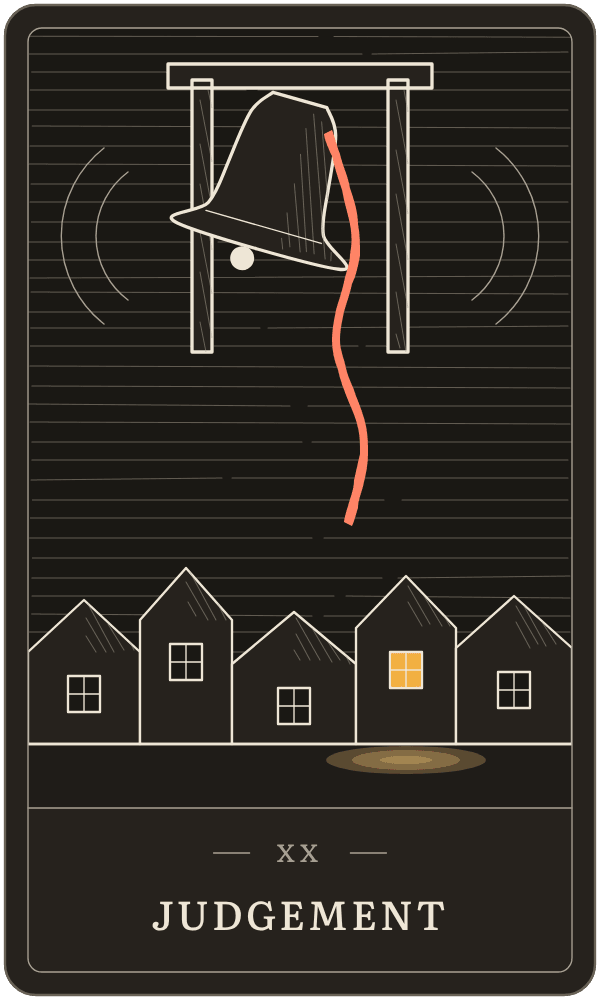
Reversed, the bell rings but the window stays dark. You may be too hard on yourself to move, or avoiding the reflection that would help. Regret can drown out a call you’d otherwise hear. The card suggests compassion toward your past self, and a little openness to who you’re becoming.
What would change if you treated your past self with more kindness?
Judgement in love
Upright
In love, Judgement can point to a meaningful reckoning, a fresh start or seeing a relationship with new clarity. It invites forgiveness and honest reassessment.
Reversed
In love, this can reflect lingering regrets, blame or difficulty letting go of past hurts. It invites forgiveness, including toward yourself.
Judgement at work
Upright
At work, it highlights a sense of calling and a chance to reassess your direction. It invites you to listen to what truly motivates you.
Reversed
At work, it may point to hesitation about a calling or fear of making the wrong choice. Learning from the past can free you rather than hold you back.
Judgement as feelings
For questions like “How do they feel about me?” The card describes a possible mood, never what someone really thinks.
Upright
A mood this card can describe: fresh clarity, and a readiness for an honest conversation. What would you want that conversation to cover?
Reversed
A mood this card can describe: regret or self-criticism, and difficulty moving past something. What needs to be said for either of you to move on?
Is Judgement a yes or no card?
Upright
Leans yes. Judgement: the call heard, and the readiness to answer it.
Reversed
Leans no. Judgement reversed: regret drowning out the call.
A lean is the card’s mood, not a verdict. Yes or no tarot can’t answer questions about health, pregnancy, money, the law or what someone else will do. Draw one card for a yes or no question, or see every card’s lean.
Judgement in Lanterndeck’s deck
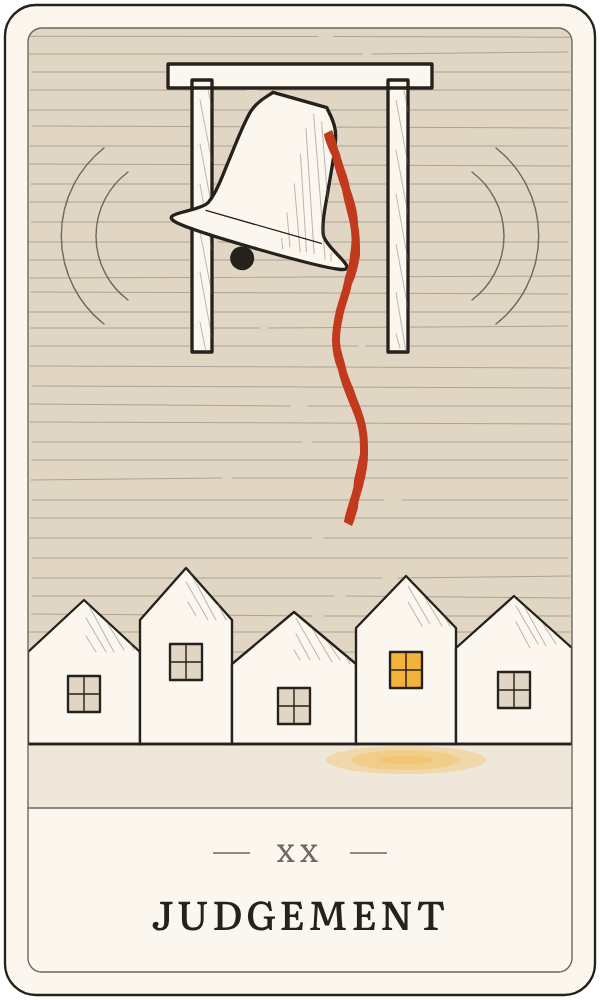
Traditional decks show an angel blowing a trumpet over figures rising from coffins with their arms raised. Lanterndeck draws a bell swinging over a row of houses just as one window lights up, with the bell rope in vermilion. The call goes out to everyone, and one house answers. Hearing it is the easy part; the card is about getting up.
Judgement in a spread
In a three-card reading
- In the past position, Judgement points to a reckoning or a realization that changed your direction.
- In the present, it suggests an honest look back, so you can choose what comes next.
- As what’s coming into view, it shows renewal: a clearer sense of what you’re called toward.
In a Celtic Cross
- Crossing you, it can show self-criticism, or regret holding you in place.
- As where things are heading, it leans toward a fresh start built on what you’ve learned.
How the positions work: the three-card spread and the Celtic Cross, position by position.
Judgement with other cards
Judgement and Justice
Accountability and renewal. Be honest about what happened, then begin again.Judgement and The World
One chapter closing with a sense of completion as the next call arrives.Judgement and Death
A deep transition: something ends, and a new sense of purpose rises.Judgement and The Hermit
Reflection that leads to a decision.
What Judgement doesn’t mean
Judgement isn’t a verdict from outside, and it doesn’t mean anyone is about to judge you. Its name is old; its meaning is renewal. The only assessment it asks for is your own, made with kindness.
Judgement by the numbers
| In a one-card draw | 1 in 78 (1.3%) |
|---|---|
| In a three-card spread | 1 in 26 (3.8%) |
| In a ten-card Celtic Cross | about 1 in 8 (12.8%) |
| Reversed, when it turns up | about 1 in 3 in Lanterndeck’s draw |
Judgement is card XX of the Major Arcana, the twenty-first of its 22 steps, between The Sun and The World. With 22 Majors in a deck of 78, a three-card spread holds at least one of them about 64 times in 100.
Draw with Judgement in mind
Ask your own question and draw three cards from the full deck. Judgement may turn up or it may not: the draw is random, and the reading works with whatever comes.