Palm reading · one of the four main lines
Fate line: what it means, and what if you don't have one
The fate line runs up the center of the palm toward the middle finger. In palm reading it describes your sense of direction: purpose, work and the paths you choose. Despite its name, it doesn’t fix anything in advance.
Many palms have no clear fate line, and many have one that comes and goes. It doesn’t mean you lack a purpose or a future. Palm readers read an absent fate line as a path you make yourself, and Lanterndeck never reads any line as fate in the literal sense.
Where to find your fate line
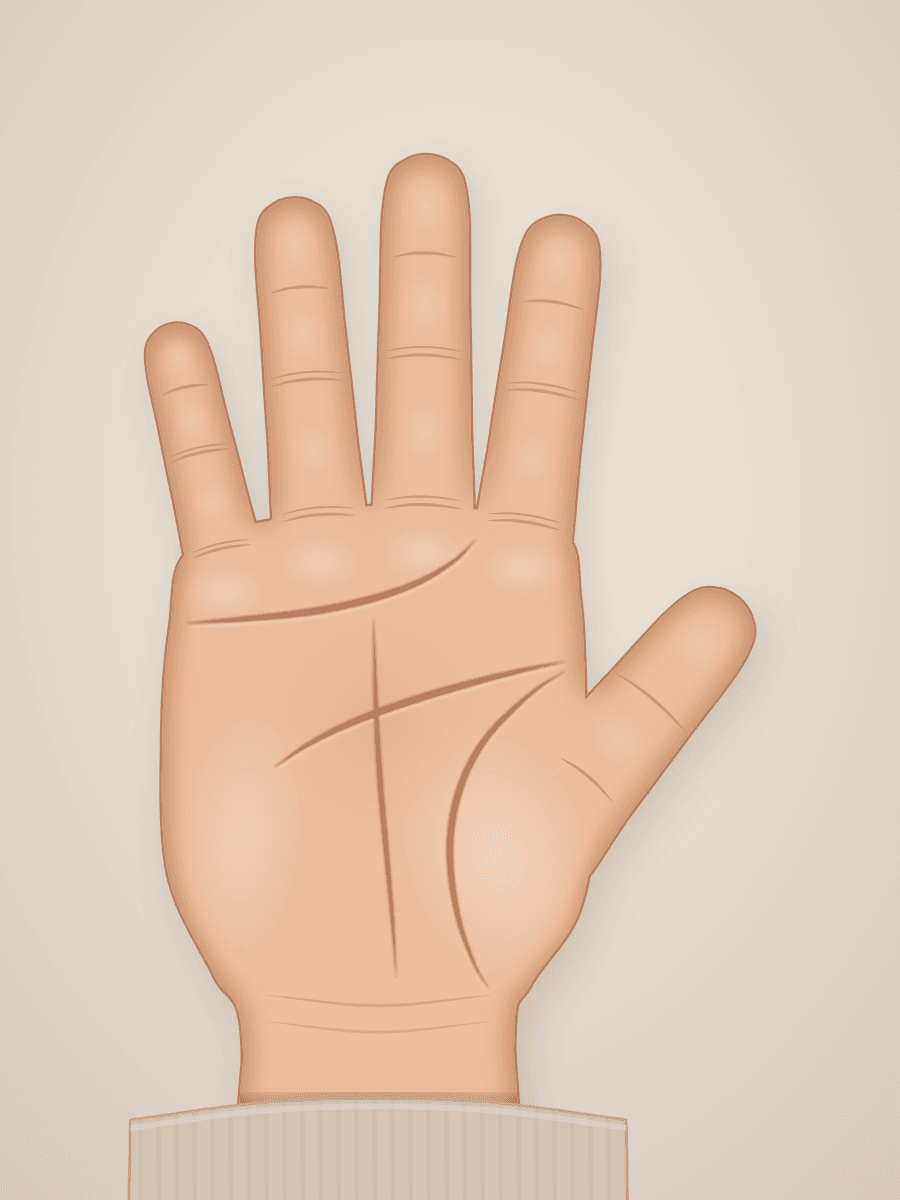
Look for a vertical crease in the middle of your palm, starting somewhere near the wrist and running up toward the middle finger. It may cross the head and heart lines, stop at one of them, or start part way up.
It’s the least predictable of the four main lines: some hands show it strongly, some faintly, some not at all. That variety is what palm readers find interesting about it.
How clearly it shows
The scanner reports whether a fate line shows clearly, faintly, or not at all in your photo.
Clear
A clear fate line is traditionally read as a strong sense of direction: you know what you’re working toward and you’re steady in pursuing it. Palm readers sometimes add a caution about holding the plan so tightly that you miss a better turn.
Faint
A faint fate line is read as a direction still forming, or a path that changes with circumstances: openness rather than drift. Many people do their best work this way.
Not visible
No visible fate line is very common. Palm readers read it as freedom from a set course: a life shaped by your choices as you go, rather than by one fixed path. It is not a sign of anything missing.
How high it rises
When a fate line shows, the scanner reports whether it rises high toward the fingers or stops part way.
Rising high
A fate line that rises high toward the middle finger is read as a purpose that runs through your life: a calling or a long project you keep returning to.
Rising part way
A fate line that stops part way, often at the head or heart line, is read as a direction that changes, or one you find later in life. Palm readers note that many people come into their own after a change of path.
Where it starts
A fate line that rises from the wrist is traditionally read as self-direction from early on. One that grows out of the life line is read as a path shaped by family or early surroundings. One that starts from the outer, little-finger side of the palm is read as a direction shaped by other people: an audience, a community, a public role.
Two fate lines, or a broken one
Some palms show two fate lines running side by side, read as two paths at once: two careers, or work alongside a calling. A broken fate line, or one that steps sideways, is read as a change of direction, often a chosen one. None of these predict a change of job; they describe how a life can have more than one thread.
What the fate line can’t tell you
It can’t predict your career, your success or your income, and Lanterndeck never reads it that way. It’s a prompt to think about direction: what you’re building, and whether it’s still yours. If that’s a live question, a career tarot reading can help you reflect.
Before you take the photo
- Use daylight from a window, not the flash. Glare hides the finer creases.
- Hold your palm flat and open, fingers together but relaxed, the whole hand and a little of the wrist in the frame.
- Keep the phone parallel to your palm, about a forearm’s length away, and tap to focus on the center of the palm.
- Use your dominant hand, the one you write with, unless you want to compare both.
- A plain background helps. Your photo is read once and deleted, never kept.
Scan your palm to see your fate line
- Palm facing the camera
- Fingers relaxed, a little apart
- Soft, even light, no flash
- Your whole hand in the frame
Take a photo or choose one. It stays on this device: read here, in your browser, never uploaded and never kept.
More palm lines
- Life line
The life line is the curved crease that sweeps around the base of your thumb.
- Head line
The head line runs across the middle of your palm, below the heart line.
- Heart line
The heart line is the highest of the major lines, running across the top of your palm just below the fingers.
- M on your palm
Look at your palm and you may see a letter M drawn in its creases.
- The beginner’s guide to palm reading lines
All four lines on one chart, hand shapes, the mounts and how to read your own palm.