Palm reading · one of the four main lines
Life line: what it means in palm reading
The life line is the curved crease that sweeps around the base of your thumb. In palm reading it describes energy, vitality and how you meet the world: your appetite for change, your need for home, the way you pace yourself.
A short, faint or broken life line does not mean a short life, and a long one doesn’t promise a long one. That idea is a myth, and Lanterndeck never reads it that way. Palm creases are skin folds that form where the hand bends, before you’re born; their length depends on the shape of your hand. Palm reading says nothing about health either: any question about your health is one for a doctor.
Where to find your life line
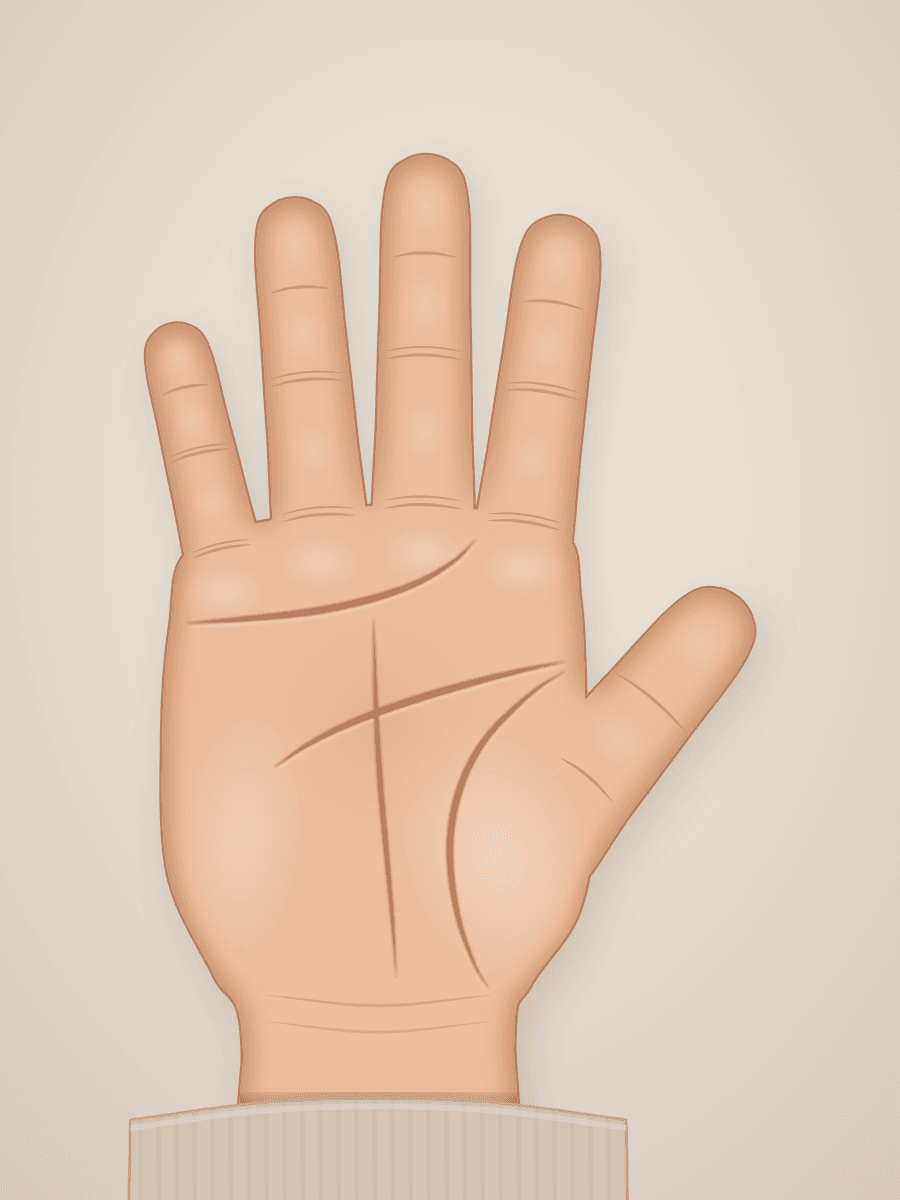
Start between your thumb and index finger, just above the head line, or sometimes sharing its first stretch. Follow the crease as it curves down around the fleshy pad at the base of your thumb (palm readers call it the mount of Venus) toward the wrist.
Some life lines sweep wide into the palm; others hug the thumb. Some run all the way to the wrist; many fade out part way. All of these are ordinary.
How wide its arc is
The scanner measures how far the life line swings out into the palm before it curves back toward the wrist.
A wide arc
A life line that sweeps well out into the palm is traditionally read as an outgoing, energetic temperament: someone who enjoys variety, new people and a full calendar, and who recovers their spark quickly. The reflective question it raises is whether you leave yourself room to rest.
Close to the thumb
A life line that stays close to the thumb is read as a more inward, home-loving energy: you may prefer familiar places and a few close people, and you spend your energy carefully. Palm readers see steadiness here, and loyalty, not a lack of vitality.
How clear it is
The scanner reports whether the line shows clearly in the photo or only faintly.
Clear
A clear, well-marked life line is traditionally read as a steady, grounded sense of self: you know what gives you energy and you tend to stay with things. In a photo, clarity also depends on light, skin and how open your hand is, so take this as a starting point.
Faint
A faint life line is read as sensitivity: energy that rises and falls with your surroundings, and a need to pace yourself and protect your quiet time. It is not a weakness, and it is never a sign about your health.
Breaks, forks and doubled lines
A break or a gap is traditionally read as a change of direction: a move, a new chapter, a shift in how you spend your energy. Where the two ends overlap, the change is said to be eased by what came before.
A second, shorter line running alongside the life line (palm readers call it a sister line) is read as support: a person, a practice or a home that steadies you.
A fork near the wrist is read as a life lived in two places or two ways, splitting your energy between them. Small lines rising from the life line toward the fingers are read as efforts and ambitions you’ve put energy into.
Common myths about the life line
The biggest myth is that the life line measures lifespan. It doesn’t, in any serious tradition of palm reading, and there’s no evidence that crease length relates to how long anyone lives. If a reading has ever worried you this way, you can set it down.
Another is that a faint or broken line means illness or an accident. Palm reading says nothing about health or about future events. Lanterndeck reads the life line only as a reflection of energy and temperament, for self-reflection and fun.
Reading it with the other lines
Where the life line begins tells you something when you read it with the head line. If the two start joined, palm readers see a careful, considered start in life; if they begin apart, independence and early confidence.
Read it beside the fate line too: a fate line that rises out of the life line is traditionally read as a direction shaped by family or early surroundings.
Before you take the photo
- Use daylight from a window, not the flash. Glare hides the finer creases.
- Hold your palm flat and open, fingers together but relaxed, the whole hand and a little of the wrist in the frame.
- Keep the phone parallel to your palm, about a forearm’s length away, and tap to focus on the center of the palm.
- Use your dominant hand, the one you write with, unless you want to compare both.
- A plain background helps. Your photo is read once and deleted, never kept.
Scan your palm to see your life line
- Palm facing the camera
- Fingers relaxed, a little apart
- Soft, even light, no flash
- Your whole hand in the frame
Take a photo or choose one. It stays on this device: read here, in your browser, never uploaded and never kept.
More palm lines
- Heart line
The heart line is the highest of the major lines, running across the top of your palm just below the fingers.
- Head line
The head line runs across the middle of your palm, below the heart line.
- Fate line
The fate line runs up the center of the palm toward the middle finger.
- M on your palm
Look at your palm and you may see a letter M drawn in its creases.
- The beginner’s guide to palm reading lines
All four lines on one chart, hand shapes, the mounts and how to read your own palm.