Palm reading · one of the four main lines
Heart line: what it says about how you love
The heart line is the highest of the major lines, running across the top of your palm just below the fingers. In palm reading it describes your emotional life: how openly you show feelings, what you need from the people close to you, and how you love.
Where to find your heart line
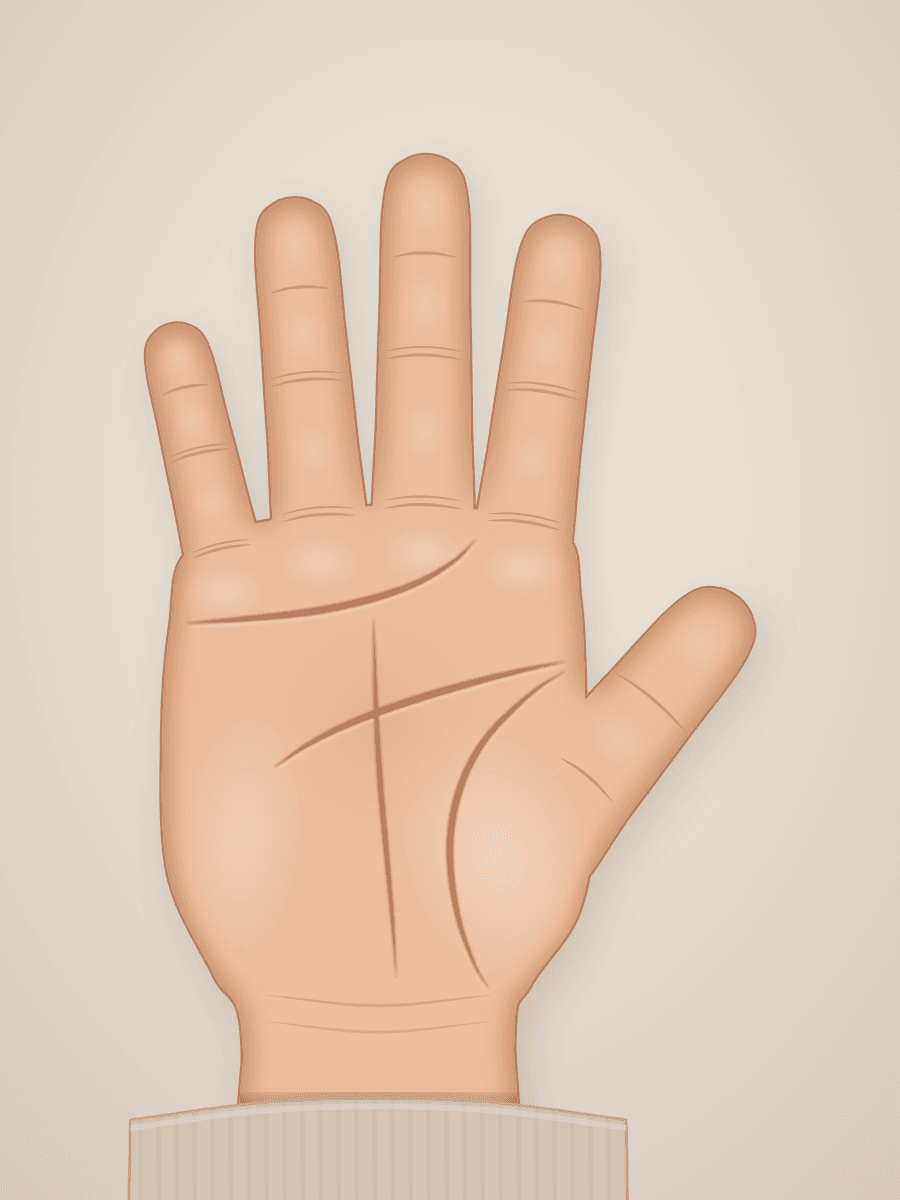
Look just below the base of your fingers. The heart line starts at the edge of your palm under the little finger and runs across toward the index and middle fingers.
It’s usually the crease nearest the fingers, and its end is the part palm readers look at most: whether it reaches under the index finger, stops under the middle finger, or curves up between them.
How long it is
The scanner measures how far the heart line runs across the palm.
Long
A heart line that runs most of the way across, toward or under the index finger, is traditionally read as emotional generosity and idealism: you give a great deal in love and friendship, and you hope for the same in return.
Medium
A heart line that ends between the middle and index fingers is read as balance: warm but discerning, able to open up without losing your footing. Palm readers call this the most even-tempered length.
Short
A heart line that stops under the middle finger is read as a private, practical approach to feeling. You may show love through what you do more than what you say, and keep your inner life for a chosen few.
Curved or fairly straight
The scanner reports whether the line bends along its length or runs fairly straight.
Curved
A curved heart line is traditionally read as an expressive heart: feelings close to the surface and easy to share, a warmth that others notice quickly.
Fairly straight
A straighter heart line is read as a thoughtful, steady way of loving: you weigh feelings before you show them, and once you do, you mean it.
How it ends
The scanner looks at the line’s last stretch: whether it rises toward the fingers or runs on level.
Curving up toward the fingers
An end that sweeps up toward the fingers is one of the warmest signs in palm reading: affection shown freely, a romantic streak, a heart worn openly.
Running level
An end that runs level across the palm is read as emotional steadiness: calm in close relationships, slow to flare up, a preference for depth over drama.
Forks, chains and breaks
A fork at the end of the heart line is traditionally read as a balance between heart and head, or between your own needs and other people’s. A small chain of loops is read as sensitivity: feelings that run deep and can be stirred easily.
A break is read as a change in your emotional life, a time you loved differently afterwards. Palm readers never read it as heartbreak to come, and neither does Lanterndeck.
Heart line and head line together
Palm readers often read the heart line against the head line below it. A wide space between them is read as an open, easygoing nature; lines that run close are read as feelings and thoughts that influence each other strongly.
When the two are joined into one crease across the palm, it’s called a simian line, which has its own folklore.
What the heart line can’t tell you
It can’t tell you whether a particular person loves you, whether a relationship will last, or when you’ll meet someone. It reflects a temperament, a way of feeling, not anyone’s choices. For the questions behind a heart line, a love tarot reading gives you something to reflect on together.
Before you take the photo
- Use daylight from a window, not the flash. Glare hides the finer creases.
- Hold your palm flat and open, fingers together but relaxed, the whole hand and a little of the wrist in the frame.
- Keep the phone parallel to your palm, about a forearm’s length away, and tap to focus on the center of the palm.
- Use your dominant hand, the one you write with, unless you want to compare both.
- A plain background helps. Your photo is read once and deleted, never kept.
Scan your palm to see your heart line
- Palm facing the camera
- Fingers relaxed, a little apart
- Soft, even light, no flash
- Your whole hand in the frame
Take a photo or choose one. It stays on this device: read here, in your browser, never uploaded and never kept.
More palm lines
- Head line
The head line runs across the middle of your palm, below the heart line.
- Life line
The life line is the curved crease that sweeps around the base of your thumb.
- Simian line
A simian line is a single crease running straight across the palm, where the heart line and head line appear as one.
- Fate line
The fate line runs up the center of the palm toward the middle finger.
- The beginner’s guide to palm reading lines
All four lines on one chart, hand shapes, the mounts and how to read your own palm.